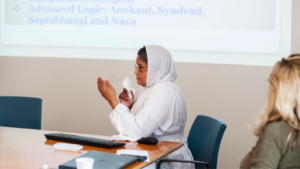
 Ghent University offers a two-year master’s program in South Asian Languages and Cultures, focusing on the rich cultural traditions of India. This research-oriented program is taught entirely in English and hybrid (online and on campus), making it accessible to students worldwide. It focuses on the study of religion (emphasizing Jainism and Buddhism), and material culture, preparing graduates for advanced research in disciplines including Religious Studies, Art History and Archaeology, and Literature. Students also have the opportunity to spend a semester at one of our partner institutions in India or Europe.
Buddhism, Jainism and material culture?
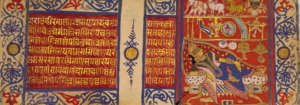
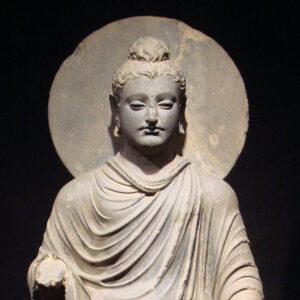
Buddhism and Jainism are two ancient religious traditions rooted in nonviolence and practices of asceticism and meditation. Originating in South Asia, Buddhism spread all across Asia, and is currently the fourth largest religion in the world. Despite being a minority religion, Jainism has profoundly influenced Indian philosophy, literature, and culture, its followers preserving India’s literary heritage for centuries. Their shared principles of nonviolence, truthfulness, and non-possessiveness remain relevant to global debates on ecology and ethics. As such, reading Jain and Buddhist sources offers a unique gateway to understanding South Asia’s intellectual history.
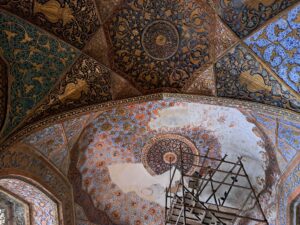
The material culture of South Asia is vast, diverse, and extraordinarily rich, ranging from religious artifacts to architectural monuments to contemporary paintings and beyond. Going back millennia, South Asian material culture often predates any textual evidence, representing an important source of information on South Asian culture. Studying South Asia’s material culture is an essential complement to the reading of texts.
Why choose this program?
Ghent University’s MA in South Asian Studies provides a solid framework of courses and activities to build academic competences relevant to budding South Asia specialists. In addition to honing their skills and understanding, students are offered the unique opportunity to advance their individual research interests under the guidance of renowned experts in religion, material culture, and Indic languages.
Highlights
- Fully hybrid, English-taught courses
- Research-oriented curriculum
- Semester abroad opportunities
- Focus on religious cultures
- Focus on material culture
- Engaging with primary materials in original languages (incl. Hindi, Sanskrit, Prakrit, Pali…)
Curriculum
The full two-year program consists of 120 ECTS credits:
Reading Religion courses: (2×6 ECTS)
Ancient, middle, and modern languages play an important role as keys to engage with primary sources. However, rather than focus on language acquisition, the MA proposes to read texts contextually, using translations and other tools where available.
- Introduction to key Indic languages, including Prakrit, Apabhramsha, Pali and Old Hindi
- Reading Jain and Buddhist texts
Material Culture courses: (2×6 ECTS)
- Introduction of South Asian material culture
- In-depth discussion of selected cases
Research Skills Development:
Students are encouraged to develop a broad understanding of ongoing academic debates and lines of research, as well as general academic skills. Depending on their personal research interest, the expert dissertation guidance and the tailored internship offered provide students with a unique position to boost their personal development and academic career.
- Culture in Perspective (6 ECTS)
- Trends and topics in Asian Studies (2×3 ECTS)
- Research Seminar (13 ECTS) and Dissertation (30 ECTS)
- Internship (12 ECTS)
International semester
Exchange semester or equivalent I@Home electives (29 ECTS)
For the full program of next year’s course, see here.
Tuition & Admission

- Tuition fees: approx. €1200–€2300 per year
- Funding: Erasmus and Flemish scholarship programs for semester abroad and internship
- Admission:
- Bachelor’s in Indology, South Asian Studies, Hindi, Sanskrit, or equivalent (Preparatory programs available for other degrees.)
- English proficiency: B2 level
- Deadlines:
- April 1 (for on-campus students requiring a Belgian visa)
- June 1 (for online students, and on-campus students not requiring a Belgian visa)
Interested?
- For further information and to check admission eligibility, contact Prof. Dr. Eva De Clercq (ev.declercq@ugent.be)
- Social: https://www.facebook.com/indischetalenenculturen | https://www.instagram.com/ugentindia/