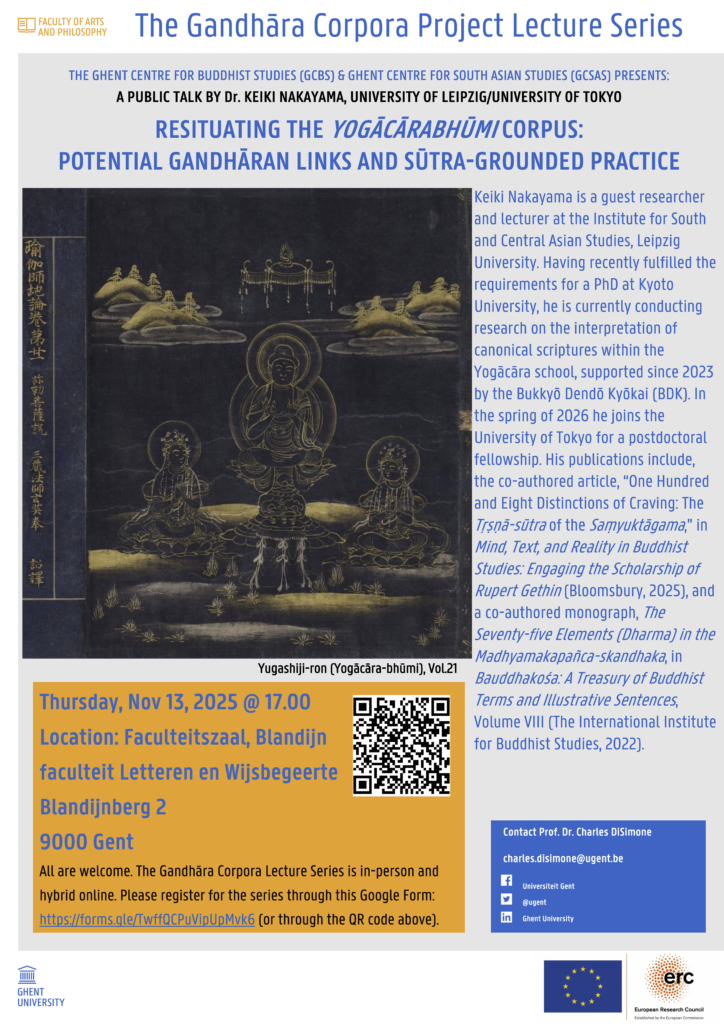
On 13 November 2025, the Ghent Centre for South Asian Studies (GCSAS) and the Ghent Centre for Buddhist Studies (GCBS) are pleased to welcome Dr Keiki Nakayama (University of Leipzig) for a lecture entitled Resituating the Yogācārabhūmi Corpus: Potential Gandhāran Links and Sūtra-Grounded Practice.
This event is part of The Gandhāra Corpora Project Lecture Series.
All are welcome: The Gandhāra Corpora Lecture Series is in-person and hybrid online.
Time & venue
- Thursday, 13 November 2025, 17:00 (5pm) CET
- Location: Faculteitszaal, Faculteit Letteren en Wijsbegeerte, Blandijnberg 2, 9000 Gent
- To attend remotely, please register through this Google Form: https://forms.gle/TwffQCPuVipUpMvk6
Abstract
The Yogācāra school, together with the Madhyamaka, is well known as one of the two major streams of Indian Mahāyāna Buddhism. Yet its foundational text, the Yogācārabhūmi, contains numerous passages that follow the modes of description characteristic of the Śrāvakayāna tradition. The author(s) of this work are thought to have belonged to a lineage that transmitted the Mūlasarvāstivāda Vinaya. Thus, while the Yogācārins were moving away from the Sarvāstivāda mainstream, they also inherited many of its scholastic and disciplinary elements.
The first part of this presentation reconsiders the position of the Yogācārabhūmi—and hence early Yogācāra—in relation to the Sarvāstivāda tradition. The Yogācāra school appears to have shared doctrinal affinities with internal Sarvāstivādin groups such as the Dārṣṭāntikas and Vibhajyavādins mentioned in the Mahāvibhāṣā. Focusing on the Gandhāra region, I examine evidence suggesting that the “Western Masters” (Pāścāttyas), associated with Gandhāra, held positions that coincide with those of the Yogācārabhūmi, thereby indicating possible intersections between Yogācāra and Gandhāran Buddhism.
Later but related materials include numerous Mūlasarvāstivāda Vinaya manuscripts discovered in Gilgit, part of Greater Gandhāra. These texts notably embed a variety of sūtras. If the sūtras employed in the Yogācārabhūmi correspond to those appeared in the Mūlasarvāstivāda Vinaya, this strengthens the view that the Yogācārabhūmi originated from a tradition closely linked to the transmitters of the Mūlasarvāstivāda Vinaya. The recently studied Dīrghāgama (Long Discourses) manuscripts from Gilgit also deserve attention.
The latter half of the talk examines how the Yogācārabhūmi actively incorporates and reinterprets sūtras within its structure of practice. Focusing on the Śrāvakabhūmi, the earliest stratum of the text, I argue that the Yogācāra school, though renowned as meditative practitioners, grounded their practice in close engagement with the words of the Buddha.
Bio
Keiki Nakayama is a guest researcher and lecturer at the Institute for South and Central Asian Studies, Leipzig University. Having recently fulfilled the requirements for a PhD at Kyoto University, he is currently conducting research on the interpretation of canonical scriptures within the Yogācāra school, supported since 2023 by the Bukkyō Dendō Kyōkai (BDK). His publications include a co-authored article with Jens-Uwe Hartmann, “One Hundred and Eight Distinctions of Craving: The Tṛṣṇā-sūtra of the Saṃyuktāgama,” in Mind, Text, and Reality in Buddhist Studies: Engaging the Scholarship of Rupert Gethin (Bloomsbury, 2025), and a co-authored monograph with Izumi Miyazaki et al., The Seventy-five Elements (Dharma) in the Madhyamakapañca-skandhaka, in Bauddhakośa: A Treasury of Buddhist Terms and Illustrative Sentences, Volume VIII (The International Institute for Buddhist Studies, 2022).